Florida’s 2026 Property Tax Amendment 3
What Florida Businesses Need to Know About Amendment 3
Florida voters will consider Amendment 3, a proposed constitutional amendment that would make significant changes to Florida's property tax system, on the November 2026 ballot.
Understand Amendment 3 Explore ResourcesFlorida's 2026 Property Tax Amendment
The proposed amendment includes changes to homestead exemptions, non-homestead property assessments, residency requirements and the use of local ad valorem tax revenue. These changes could have implications for Florida businesses, renters, homeowners and local communities.
The Florida Chamber of Commerce is committed to helping Florida's business community and voters understand the proposed changes and their potential impacts. This page will serve as a resource for the latest developments, analysis and educational materials related to Amendment 3 as Florida approaches the November election.
Understanding Amendment 3
If approved by at least 60 percent of Florida voters, Amendment 3 would make several changes to Florida's property tax system, including increasing the homestead exemption for qualifying residents, reducing the annual assessed value increase cap for non-homestead properties from 10 percent to 5 percent, establishing new residency requirements for the increased homestead exemption and limiting the use of county and municipal ad valorem tax revenue to specified core services.
Understanding how these provisions interact with Florida's existing property tax system is important for businesses and communities across the state.

Florida's Property Tax Discussion
“I think it’s going to be pretty hard to get to 60% once all the voices come out on that, and I suspect the 2027 Tax and Budget Reform Commission will be looking closely at putting something else on the ballot in 2028 for voters to consider.”
Get the Facts on Amendment 3
Start with these Florida Chamber resources to understand what Amendment 3 proposes and how Florida's current property tax system works.
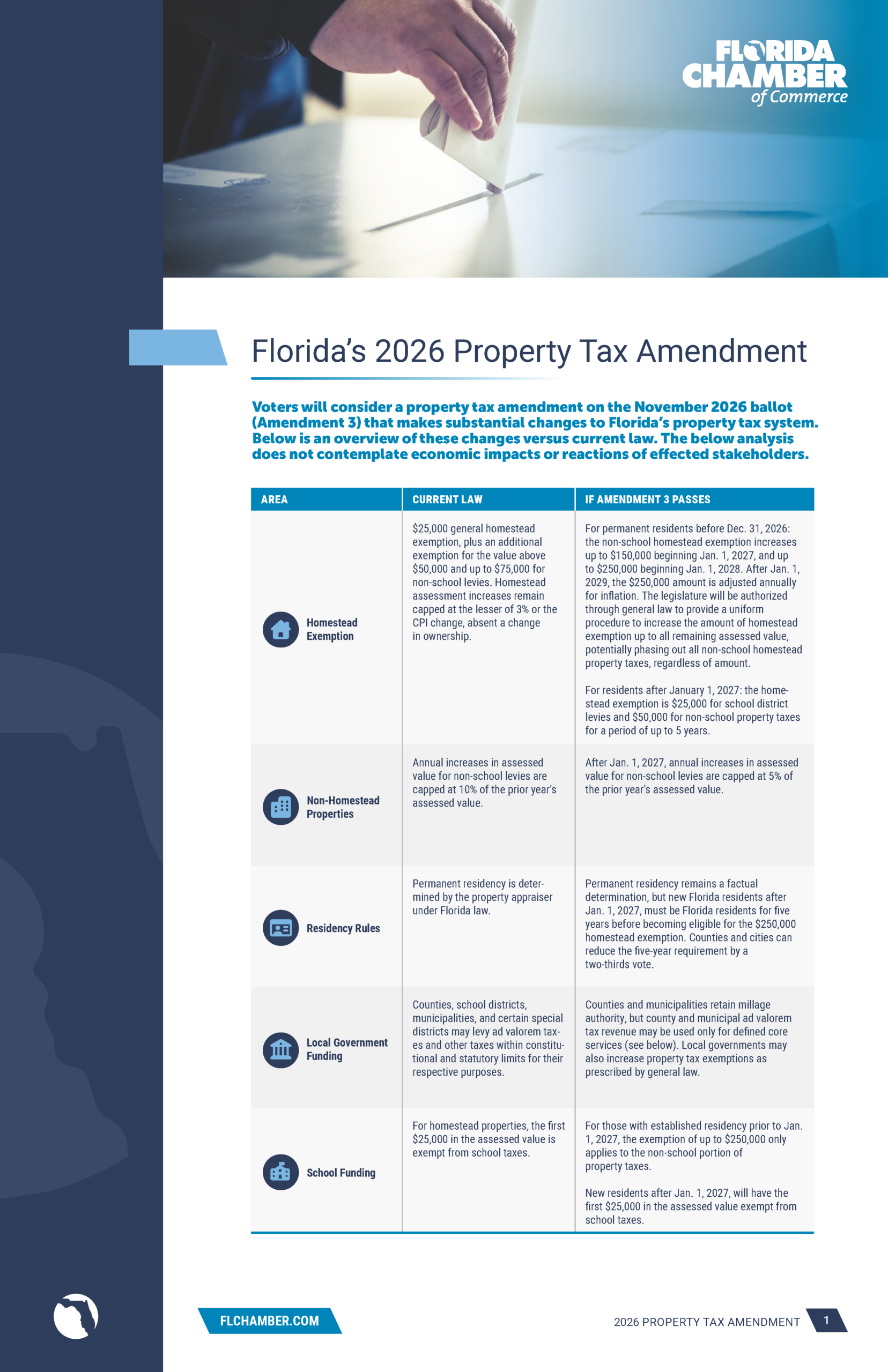
Property Tax Amendment Brief: Current Law vs. Proposed Changes
See a side-by-side comparison of Florida's current property tax system and the changes proposed under Amendment 3.
View the Comparison
Understand How Florida's Property Tax System Works
Learn about Florida's existing property tax system, including homestead and non-homestead classifications and property tax collections.
Read the PrimerWhat Would Amendment 3 Change?
Homestead Exemption
The homestead exemption for non-school taxes would increase to $150,000 in 2027 and $250,000 in 2028, with inflation adjustments thereafter.
Non-Homestead Property
The annual cap on assessment increases for non-homestead property would decrease from 10 percent to 5 percent.
Residency Requirements
New provisions would govern when certain new Florida residents qualify for the increased homestead exemption.
Local Property Tax Revenue
The amendment would establish constitutional provisions addressing how counties and municipalities may use property tax revenue.
Who Could Be Affected by Amendment 3?
Amendment 3 includes changes affecting both homestead and non-homestead property and could have broader implications for local property tax collections. Understanding which provisions apply to different types of property can help Floridians evaluate how the amendment may affect them and their communities.
Florida Homeowners
Qualifying homestead property owners would be directly affected by the proposed increase in the homestead exemption for non-school property taxes. The amendment also establishes different timing for the increased exemption for certain new Florida residents.
Businesses & Commercial Property
Commercial property is generally classified as non-homestead property. Amendment 3 would reduce the annual cap on assessment increases for non-homestead property from 10 percent to 5 percent.
Renters & Rental Property
Rental and investment properties generally do not qualify for the increased homestead exemption. Non-homestead residential property would be subject to the proposed 5 percent annual assessment increase cap.
Local Communities & Governments
The amendment would affect local property tax collections and includes provisions governing the use of county and municipal property tax revenue. Estimated fiscal impacts vary by county.
Explore Amendment 3 by County
Estimated revenue impacts vary across Florida's 67 counties. Select a county below to explore its estimated fiscal impact and county government operating millage rate assuming property values remain flat and the millage rate remains unchanged.
Figures are shown in millions. Parentheses indicate estimated reductions in revenue. County-level estimates and operating millage rates are presented for educational purposes.
Data sources: Florida Department of Revenue and Florida Office of Economic and Demographic Research.
Perspectives on Amendment 3
Organizations and leaders across Florida have expressed different perspectives on Amendment 3. The statements below are provided to help visitors understand the broader discussion surrounding the proposal.
Florida Realtors supports Amendment 3 because it offers voters an opportunity to provide meaningful property tax relief while strengthening Florida's commitment to attainable homeownership.
In its current form, I fear the proposal will devastate counties' and cities' ability to deliver vital services, including emergency services, to our citizens.
Decisions about how to fund local services work best when they are made close to the people who live with them. Property taxes are local by design.
The Florida Sheriffs Association is significantly concerned with Constitutional Amendment 3 and the potential impacts on local budgets and services.
Tax relief and reliable emergency services are not mutually exclusive, but both require responsible long-term planning.
Amendment 3 Updates
Revised Amendment 3 Ballot Language Released
Attorney General James Uthmeier released a revised ballot title and summary for Amendment 3 following a Leon County Circuit Court ruling that found portions of the original ballot language misleading and inaccurate.
The underlying proposed constitutional amendment remains unchanged. The revised language addresses how the proposal will be described to voters on the November ballot.
This amendment increases the homestead exemption, for all non-school taxes, to $150,000 in 2027 and $250,000 in 2028, and adjusts for inflation thereafter. It requires the Legislature to prescribe a uniform procedure for counties and municipalities, for their respective levies, to increase the homestead exemption up to full assessed value, and allows special districts, subject to referendum approval, to do the same.
Persons who are not Florida residents on December 31, 2026, will receive the existing homestead exemption upon qualifying for a homestead exemption, with the increased homestead exemption beginning with the fifth year of exemption, to the extent permitted by the U.S. Constitution.
This amendment reduces the annual cap on assessment increases for non-homestead properties from 10% to 5%.
This amendment requires counties and municipalities to use property taxes solely for public safety, education and schools, infrastructure, natural resources, bond debt service, retirement benefits for employees, and operations and administration. Other expenditures may be approved by county officers or county or municipal governing bodies unless prohibited by general law, notwithstanding Article VII, Section 9(a) of the Florida Constitution, which allows counties and municipalities to levy property taxes for their respective purposes.
This amendment takes effect January 1, 2027.
The Florida Chamber will continue to monitor developments related to Amendment 3 and provide updates to Florida's business community as they occur.
Court Rules Original Amendment 3 Ballot Language Misleading and Inaccurate
Leon County Circuit Court Judge David Frank ruled that the original ballot title and summary for Amendment 3 contained misleading and inaccurate language and identified specific provisions that required revision. The ruling directed the Attorney General to prepare a new ballot title and summary following the conclusion of any appeals. The Florida Chamber provided an update to Florida's business community outlining the ruling, next steps and potential implications for non-homestead properties, including local businesses.
This was the original ballot title. It was subsequently replaced by the current title shown above.
Amendment 3 FAQs
What is Amendment 3?
Amendment 3 is a proposed amendment to the Florida Constitution addressing homestead exemptions, non-homestead property assessments, residency requirements and provisions governing county and municipal property tax revenue.
When will Floridians vote on Amendment 3?
Amendment 3 is scheduled to appear on Florida's November 3, 2026 General Election ballot.
How much voter approval does Amendment 3 need?
At least 60 percent of voters voting on the measure must approve a proposed amendment for it to become part of the Florida Constitution.
What does voting YES mean?
A YES vote approves Amendment 3 and adds the proposed property tax changes contained in the amendment to the Florida Constitution.
What does voting NO mean?
A NO vote rejects Amendment 3. The proposed constitutional changes contained in Amendment 3 would not take effect through this measure.
How would the homestead exemption change?
The amendment would increase the homestead exemption for non-school taxes to $150,000 in 2027 and $250,000 in 2028, with inflation adjustments thereafter.
Would the increased exemption apply to school taxes?
No. The increased homestead exemption proposed by Amendment 3 applies to non-school property taxes.
How would Amendment 3 affect commercial property?
Commercial property is generally classified as non-homestead property. Amendment 3 would reduce the annual cap on assessment increases for non-homestead property from 10 percent to 5 percent.
How would Amendment 3 affect rental property?
Non-homestead rental property would be subject to the proposed reduction in the annual assessment increase cap from 10 percent to 5 percent.
How are new Florida residents addressed?
People who are not Florida residents on December 31, 2026, would receive the existing homestead exemption upon qualifying, with the increased exemption beginning with the fifth year of exemption, to the extent permitted by the U.S. Constitution.
What is a millage rate?
A millage rate is the rate used to calculate property taxes. One mill represents $1 in tax for every $1,000 of taxable property value.
When would Amendment 3 take effect?
If approved, the amendment states that it would take effect January 1, 2027.
Did the Amendment 3 ballot title change?
Yes. The original ballot title was replaced following an August 2026 Leon County Circuit Court ruling. The current official title is displayed in the Updates section above.
Where can I read the official ballot language?
The current official ballot title, summary and related materials are available through the Florida Department of State and linked below.
Amendment 3 & Property Tax Resources
Amendment 3 Comparison
Compare current law with the changes proposed under Amendment 3.
View Comparison →Florida Property Tax Primer
Learn how Florida's existing property tax structure works.
Read Primer →Florida Chamber Property Tax Letter
Review the Florida Chamber's letter addressing Florida property tax policy.
Read Letter →Official Amendment 3 Information
Review current official ballot information from the Florida Department of State.
View Official Information →Court Ruling
Review the court ruling addressing the original Amendment 3 ballot title and summary.
View Court Ruling →Jax Tax Facts
Explore additional educational information focused on Amendment 3 and Jacksonville.
Visit Resource →Vote YES on 3
Review information and arguments presented by the campaign supporting Amendment 3.
Explore Perspective →Vote No on 3
Review information and arguments presented by the campaign opposing Amendment 3.
Explore Perspective →Stay Informed
The Florida Chamber will continue to provide updates, data and educational resources related to Amendment 3 as Florida approaches the November election.
For questions about Amendment 3 or Florida's property tax system, contact Carolyn Johnson, Vice President of Government Affairs, at 850-521-1235 or cjohnson@flchamber.com.
Contact Carolyn