2026 Florida Economic & Business Mid-Year Report

See How Migration, Inflation, Housing, and the Labor Market Are Shaping Florida's Economy in 2026
Florida entered 2026 building upon the foundation of economic momentum: strong population growth, major corporate headquarters moving to Florida, job growth that has outpaced the nation for many years, and low unemployment.
Now, at the midpoint of 2026, both the national and state economies have experienced slowdowns. This report analyzes what is true about Florida’s economy so Florida’s business community can make smart decisions in the second half of 2026.
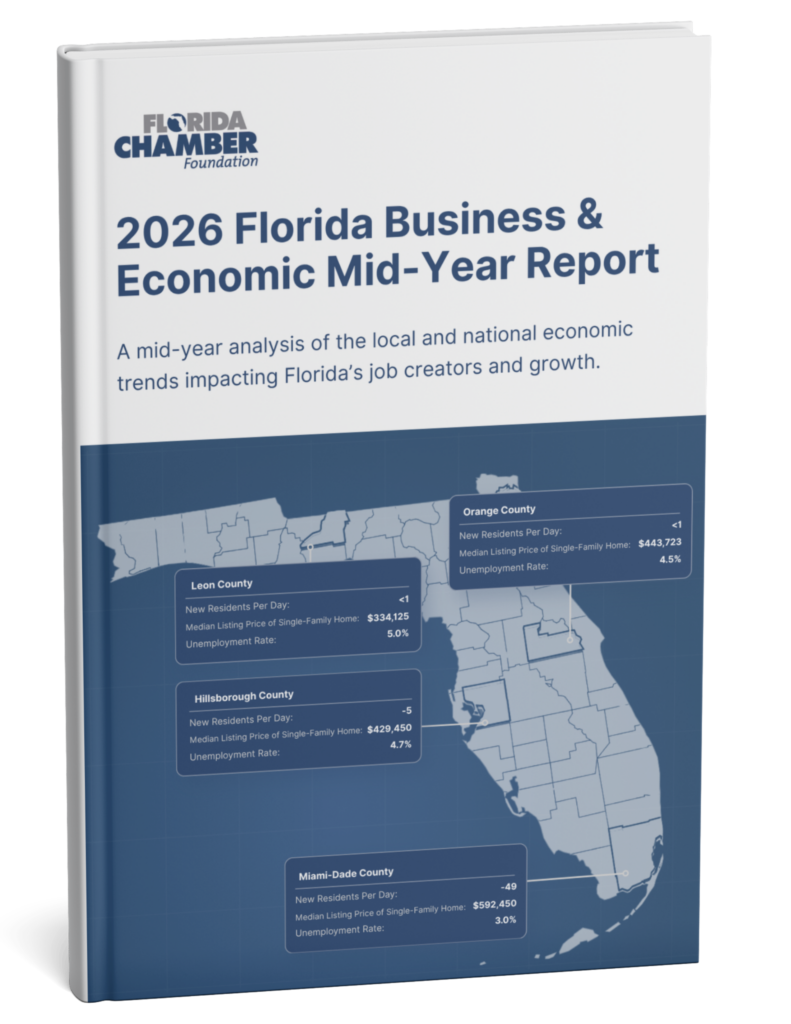
Explore Florida's Economy By Topic
Select a topic below to view key data and analyses on the state of Florida's economy at the midpoint of 2026.
Migration of people into Florida has been a driver of Florida’s economic growth in recent years, and taking stock of these trends is important context for Florida’s economy halfway through 2026
551 People Move to Florida Every Day
The number of people moving to Florida per day increased rapidly from 2020 to 2023, and then saw steady declines to the current number of 551.
As overall net migration has slowed, international migration to Florida has made up a larger portion of this population growth. In 2025, 89% of Florida’s net migration was from other countries, and 11% was from other U.S. states.
County-Level Migration Trends in Florida
This story varies across Florida’s 67 counties. Of all the counties, seven had an overall negative net migration annually, primarily due to net negative domestic migration.
Who Is Choosing Florida?
On average, those moving into Florida are older, more educated, more likely to own a home, and have higher incomes than those moving out.
Moving Into Florida
Average Age: 35.4 Years Old
47% Have a Bachelor’s Degree or Higher
53% are Homeowners
$41,038 Average Income
Moving Out Of Florida
Average Age: 32.2 Years Old
43% Have a Bachelor’s Degree or Higher
42% are Homeowners
$37,198 Average Income
Rising Prices Dampen Consumer Sentiment
Even as economic indicators like GDP and the labor market move upward, rising prices and consumer sentiment shed light on future economic trends.
The national inflation rate of 3.5% is primarily driven by housing and transportation costs.
The Stock Market Doesn't Tell the Whole Story
The stock market is one picture of the economy, but 4 out of 10 Americans have no stock holdings.
Consumer sentiment matters, because household spending, political sentiment, and migration trends are all fueled by how consumers feel about the economy.
Although the stock market trends upward, Florida’s consumer sentiment is trending downward.
Florida's Housing Market Continues to Grow, Defying Expectations
While many expected Florida’s housing market to see annual drops in sales in 2026, this has not been the case so far. In fact, Florida’s single-family housing sales were up year over year for the 10th consecutive month in June 2026.
10 Months
Florida saw ten consecutive months of annual single-family home sales increases
Source: Florida Realtors
20% Decrease
Florida’s single-family housing market has 4.5 months of inventory, compared to 5.6 a year ago.
Source: Florida Realtors
Florida's Housing Market Is Heading for a Correction, Not a Crash
From May 2021 to May 2022, the value of Florida’s typical single-family home increased by 28%, the largest annual jump in value in recent history. However, in the last year, the value of a typical single-family home in Florida has fallen by 3%. Not a sign of a crash but a downward correction.
45 of the 67 counties seeing a decline in value over the past year. The counties with increasing single family home values are concentrated in central north Florida.
The State of Florida's Job Market
Florida’s labor market surpassed 10,000,000 jobs for the first time in early 2025, and Florida’s annual non-agricultural job growth rate outpaced the nation almost every month until the last months of 2025.
Florida experienced five consecutive months of annual job losses from November 2025 to April 2026, until finally seeing small increases in April, May, and June of 2026. These three consecutive months of job increases could mean a changing tide for the job market.
Unemployment in Florida
Florida’s average unemployment rate year to date has surpassed 4%, driven by young workers. High unemployment is primarily due to a slowdown in hiring due to uncertainty surrounding economic conditions, rather than widespread layoffs.
From January to June 2026, workers were unemployed for 25 weeks on average, five weeks longer than the same period in 2025.
Florida Employment Trends by Industry
High-wage industries, like Information and Finance & Insurance (both paying an average of over $130k annually), also saw the highest percentage loss in jobs over the past year.
Pay (and growth) within industries can vary greatly as you zoom in to specific occupations, but at a high level, the numbers show a slow decline in the higher wage industries, which often require higher education levels.